Showing posts with label history. Show all posts

Thursday, September 11, 2008

9/11 + seven years

Each of us remembers where we were and what we were doing when the world as had had known it ceased to exist on that otherwise beautiful late summer morning. I've not talked much or written about that day, what one of my old psychology professors called a "flashbulb memory."

I was in our television studio / distance learning classroom teaching a teacher how to interact with students who were elsewhere (in the physical sense.) The first word was that there had been some kind of horrible aviation accident in New York, and so we continued the morning's lesson. Then another phone call from our receptionist a few minutes later ended any pretense of productive work that day.

I remember walking across the campus from the studio to my office. It was so still. Earily still, as iff the plants, the birds, and the wind all knew something big was happening. Back at the office, the conference room was full; coworkers watched the live feeds and tape loops from CNN, Fox News, NBC, and CBS. I saw the first replay of the second plane, and then the news out of Washington of a fire at the Pentagon. Within a few minutes, it was confirmed; a third plane into a building.

United Flight 93 had just a few minutes prior flown overhead (not directly above our campus, but nearly over my home about 20 miles away) - the battle for control of the cockpit apparently underway. We knew nothing of this at the moment. The telephone, cell phone, and Internet networks were straining under a massive traffic load, but I managed to get through to my wife. She was worried about our daughter who was driving back from Baltimore that morning. Then came word of a possible fourth hijacked plane; a plane that might be over Western Pennsylvania on a heading for Washington. A few moments later, the local TV station (the one where I had worked for 20 years) began reporting a plane crash in Somerset County. I knew this had to be that mystery fourth plane. Within a couple of hours, the local station was showing live shots of the crash scene. I watched the reporter doing what would have been my job three years earlier. Jon Myers was a tall kid; he grew up that day, reporting from the crash scene. It was at that moment I realized that I did not miss the news business; I was happy to be a consumer. And the news on this day was overwhelming. "Only" 3,000 dead in the collapse of the World Trade Center. It was miraculous that the toll was not higher, but even so, wrenching to the mind and soul.

Later we began hearing reports of heroism aboard Flight 93, while watching the columns of smoke rise above the New York skyline, seeing the beginnings of the effort that quickly transitioned from rescue to recovery, seeing the look on President Bush's face as he was informed of the attack while reading to the young schoolchildren, of hearing the fear in my daughter's voice as she finally got through on her cell phone, asking what has happened and what to do. So many images compressed into one large memory.

Now, seven years later, we hear the tinfoil hat crowd question the facts of that day. We see politicians wanting us to put that day behind us, lest we remember our resolve as Americans to rid the world of the animals who would do such a thing,

We must learn from the events of that day seven years ago.

We must remember.


Wednesday, July 9, 2008

How I spent the July 4th holiday

It's been rather busy here in the land of the MainyYak.
My town has just completed a nearly month-long Centennial celebration that concluded last Sunday (7/6/08) with a banquet for 400 people (that's over half the town's population.)
About three weeks ago the young lady in charge of organizing the banquet called me and called in a marker from about ten year ago. Back in those heady final years of the 20th Century when we were still anticipating the opportunity to "party like it's 1999" Franki extracted from me the promise that I would help her produce a video on the town's history when the centennial rolled around in 2008. Long story short, she was in a panic, and not just with the video project. It seems nobody had a clue about how to put together the speaking portion of the banquet.
And so, I got to emcee the event, arrange the program to accommodate all the planned speakers (and fit in a last minute addition,) and produce the historical video. I managed to finish the video in time, and if you are so incline, can check it out.


The last minute speaker is a guy named Frank Grata. He has moved to Las Vegas where he's seeking his fortune as a comic; specifically a "tribute act." The dude looks more like Rodney Dangerfield than Rodney himself. And he gets even less respect. He reports that one time when he brought a hooker to his room and he dropped his pants, she dropped her price. Check him out at www.rodney2.com.

Friday, July 4, 2008

A little light reading

This document, laboriously drafted by a committee, should be read and reread. We owe it to the Founders, to ourselves, and to all who will come.


IN CONGRESS, JULY 4, 1776

The unanimous Declaration of the thirteen united States of America

When in the Course of human events it becomes necessary for one people to dissolve the political bands which have connected them with another and to assume among the powers of the earth, the separate and equal station to which the Laws of Nature and of Nature's God entitle them, a decent respect to the opinions of mankind requires that they should declare the causes which impel them to the separation.

We hold these truths to be self-evident, that all men are created equal, that they are endowed by their Creator with certain unalienable Rights, that among these are Life, Liberty and the pursuit of Happiness. — That to secure these rights, Governments are instituted among Men, deriving their just powers from the consent of the governed, — That whenever any Form of Government becomes destructive of these ends, it is the Right of the People to alter or to abolish it, and to institute new Government, laying its foundation on such principles and organizing its powers in such form, as to them shall seem most likely to effect their Safety and Happiness. Prudence, indeed, will dictate that Governments long established should not be changed for light and transient causes; and accordingly all experience hath shewn that mankind are more disposed to suffer, while evils are sufferable than to right themselves by abolishing the forms to which they are accustomed. But when a long train of abuses and usurpations, pursuing invariably the same Object evinces a design to reduce them under absolute Despotism, it is their right, it is their duty, to throw off such Government, and to provide new Guards for their future security. — Such has been the patient sufferance of these Colonies; and such is now the necessity which constrains them to alter their former Systems of Government. The history of the present King of Great Britain is a history of repeated injuries and usurpations, all having in direct object the establishment of an absolute Tyranny over these States. To prove this, let Facts be submitted to a candid world.

He has refused his Assent to Laws, the most wholesome and necessary for the public good.

He has forbidden his Governors to pass Laws of immediate and pressing importance, unless suspended in their operation till his Assent should be obtained; and when so suspended, he has utterly neglected to attend to them.

He has refused to pass other Laws for the accommodation of large districts of people, unless those people would relinquish the right of Representation in the Legislature, a right inestimable to them and formidable to tyrants only.

He has called together legislative bodies at places unusual, uncomfortable, and distant from the depository of their Public Records, for the sole purpose of fatiguing them into compliance with his measures.

He has dissolved Representative Houses repeatedly, for opposing with manly firmness his invasions on the rights of the people.

He has refused for a long time, after such dissolutions, to cause others to be elected, whereby the Legislative Powers, incapable of Annihilation, have returned to the People at large for their exercise; the State remaining in the mean time exposed to all the dangers of invasion from without, and convulsions within.

He has endeavoured to prevent the population of these States; for that purpose obstructing the Laws for Naturalization of Foreigners; refusing to pass others to encourage their migrations hither, and raising the conditions of new Appropriations of Lands.

He has obstructed the Administration of Justice by refusing his Assent to Laws for establishing Judiciary Powers.

He has made Judges dependent on his Will alone for the tenure of their offices, and the amount and payment of their salaries.

He has erected a multitude of New Offices, and sent hither swarms of Officers to harass our people and eat out their substance.

He has kept among us, in times of peace, Standing Armies without the Consent of our legislatures.

He has affected to render the Military independent of and superior to the Civil Power.

He has combined with others to subject us to a jurisdiction foreign to our constitution, and unacknowledged by our laws; giving his Assent to their Acts of pretended Legislation:

For quartering large bodies of armed troops among us:

For protecting them, by a mock Trial from punishment for any Murders which they should commit on the Inhabitants of these States:

For cutting off our Trade with all parts of the world:

For imposing Taxes on us without our Consent:

For depriving us in many cases, of the benefit of Trial by Jury:

For transporting us beyond Seas to be tried for pretended offences:

For abolishing the free System of English Laws in a neighbouring Province, establishing therein an Arbitrary government, and enlarging its Boundaries so as to render it at once an example and fit instrument for introducing the same absolute rule into these Colonies

For taking away our Charters, abolishing our most valuable Laws and altering fundamentally the Forms of our Governments:

For suspending our own Legislatures, and declaring themselves invested with power to legislate for us in all cases whatsoever.

He has abdicated Government here, by declaring us out of his Protection and waging War against us.

He has plundered our seas, ravaged our coasts, burnt our towns, and destroyed the lives of our people.

He is at this time transporting large Armies of foreign Mercenaries to compleat the works of death, desolation, and tyranny, already begun with circumstances of Cruelty & Perfidy scarcely paralleled in the most barbarous ages, and totally unworthy the Head of a civilized nation.

He has constrained our fellow Citizens taken Captive on the high Seas to bear Arms against their Country, to become the executioners of their friends and Brethren, or to fall themselves by their Hands.

He has excited domestic insurrections amongst us, and has endeavoured to bring on the inhabitants of our frontiers, the merciless Indian Savages whose known rule of warfare, is an undistinguished destruction of all ages, sexes and conditions.

In every stage of these Oppressions We have Petitioned for Redress in the most humble terms: Our repeated Petitions have been answered only by repeated injury. A Prince, whose character is thus marked by every act which may define a Tyrant, is unfit to be the ruler of a free people.

Nor have We been wanting in attentions to our British brethren. We have warned them from time to time of attempts by their legislature to extend an unwarrantable jurisdiction over us. We have reminded them of the circumstances of our emigration and settlement here. We have appealed to their native justice and magnanimity, and we have conjured them by the ties of our common kindred to disavow these usurpations, which would inevitably interrupt our connections and correspondence. They too have been deaf to the voice of justice and of consanguinity. We must, therefore, acquiesce in the necessity, which denounces our Separation, and hold them, as we hold the rest of mankind, Enemies in War, in Peace Friends.

We, therefore, the Representatives of the united States of America, in General Congress, Assembled, appealing to the Supreme Judge of the world for the rectitude of our intentions, do, in the Name, and by Authority of the good People of these Colonies, solemnly publish and declare, That these united Colonies are, and of Right ought to be Free and Independent States, that they are Absolved from all Allegiance to the British Crown, and that all political connection between them and the State of Great Britain, is and ought to be totally dissolved; and that as Free and Independent States, they have full Power to levy War, conclude Peace, contract Alliances, establish Commerce, and to do all other Acts and Things which Independent States may of right do. — And for the support of this Declaration, with a firm reliance on the protection of Divine Providence, we mutually pledge to each other our Lives, our Fortunes, and our sacred Honor.

— John Hancock

New Hampshire:
Josiah Bartlett, William Whipple, Matthew Thornton

Massachusetts:
John Hancock, Samuel Adams, John Adams, Robert Treat Paine, Elbridge Gerry

Rhode Island:
Stephen Hopkins, William Ellery

Connecticut:
Roger Sherman, Samuel Huntington, William Williams, Oliver Wolcott

New York:
William Floyd, Philip Livingston, Francis Lewis, Lewis Morris

New Jersey:
Richard Stockton, John Witherspoon, Francis Hopkinson, John Hart, Abraham Clark

Pennsylvania:
Robert Morris, Benjamin Rush, Benjamin Franklin, John Morton, George Clymer, James Smith, George Taylor, James Wilson, George Ross

Delaware:
Caesar Rodney, George Read, Thomas McKean

Maryland:
Samuel Chase, William Paca, Thomas Stone, Charles Carroll of Carrollton

Virginia:
George Wythe, Richard Henry Lee, Thomas Jefferson, Benjamin Harrison, Thomas Nelson, Jr., Francis Lightfoot Lee, Carter Braxton

North Carolina:
William Hooper, Joseph Hewes, John Penn

South Carolina:
Edward Rutledge, Thomas Heyward, Jr., Thomas Lynch, Jr., Arthur Middleton

Georgia:
Button Gwinnett, Lyman Hall, George Walton

Monday, May 19, 2008

The Greatest Generation & the latest generation

I'll be updating this one shortly. I have a lot to say.
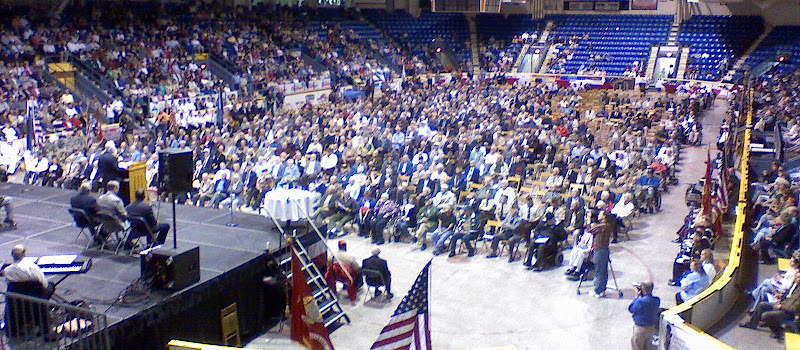
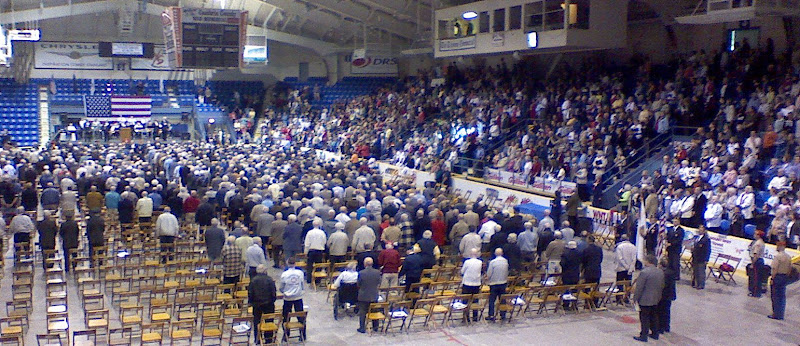
For now, take a look at nearly 1,000 representatives of the "Greatest Generation" - World War 2 veterans from Cambria County, Pennsylvania.

From WWII Vets Hon...


From WWII Vets Hon...

Thursday, May 15, 2008

Quote of the day

"War is an ugly thing, but not the ugliest of things. The decayed and degraded state of moral and patriotic feeling which thinks that nothing is worth war is much worse. The person who has nothing for which he is willing to fight, nothing which is more important than his own personal safety, is a miserable creature and has no chance of being free unless made and kept so by the exertions of better men than himself."

John Stuart Mill (1806 - 1873)

h/t The Quotations Page

Thursday, February 21, 2008

Anybody know how to trim the wick on a whale oil lamp?

Anybody remember how to use a slide rule? Do you even know what a slide rule is? Back in the days of rotary telephones, manual typewriters, and choke controls to help start cars on cold mornings, slide rules were essential tools in the physics classroom.

Today they are obsolete, as are these:
1. Dialing a rotary phone
2. Putting a needle on a vinyl record
3. Changing tracks on an eight-track tape
4. Shorthand
5. Using carbon paper to make copies
6. Basking in the lilting aroma of freshly "run-off" mimeograph paper
7. Changing the ball or ribbon on your Selectric Typewriter
8. Getting off the couch to change channels or adjust the rabbit ears on your TV set
9. Popping popcorn over the stove in a pot with oil
10. Changing the gas mixture on your car's carburetor

I recall them all, and had those mad skills (except for the shorthand, although many people thought my
handwriting looked like shorthand) back in the day. Some other obsolete skills are of more recent vintage.

Do you recall:
11. Editing an autoexec.bat or config.sys file
12. Calling "collect" and/or "person to person" on a payphone
13. Transferring files with Zmodem
14. Parking a hard disk
15. Cleaning the head of a VCR
16. Aiming a C-band satellite dish
17. Degaussing a CRT monitor
18. Lotus 1-2-3
19. WordStar 2000
20. Winding a watch

The point of all this is to illustrate not only how much things have changed over the past couple of decades, but
how much the velocity of change is increasing. I shamelessly "borrowed" these from the obsolete skills wiki and
a posting by Robert Scobel.

Now I feel old. Guess I'll brush up on my DOS command line syntax before saddling up the mule for the ride home.

Friday, November 2, 2007

What hath Leo Rosenberg wrought?

The 2008 presidential election is one year away and already we've been subjected to 24/7 campaign coverage since this time a year ago.

It began innocently enough on November 2, 1920 on the roof of a Westinghouse Electric Company building in East Pittsburgh, Pennsylvania when Leo Rosenburg began coverage of the 1920 presidential election returns on the world's first commercial radio station, KDKA. That first night of election coverage relied on information being relayed by telephone from a local newspaper, allowing about one thousand listeners to learn James Cox had lost to Warren Harding.

Since then radio (and later television) news organizations continued efforts to reduce the time between voters marking their ballots and learning the results; giving Election Day the appearance of a sporting event rather than something more substantive.

More importantly, and I fear to our detriment, this need for speed has ushered in the age of electronic voting. The aim is to make results known more quickly. The price is less accountability since the manufacturers have convinced our political leaders that a paper trail is not necessary. It really does not matter whether we learn the results of the election at 8:01 PM on election night, or a week later. What is important is that the votes are recorded and counted accurately. We need not return to pencil and paper for this; simply require that each electronic voting machine print an itemized receipt for the voter to review and then place into the ballot box. Ed Mierzwinski of the federation of state Public Interest Research Groups offers additional insight on the issue of receipts. Kim Zetter's blog at Wired has an article on the Federal Election Assistance Commission's effort to collect public input on e-voting security. And, an article in the Illinois Business Law Journal suggests e-voting machines be based on open source software as one way to mitigate the potential for fraud.

We cannot turn back time, but we can decide that getting it right is more important than getting it fast.